
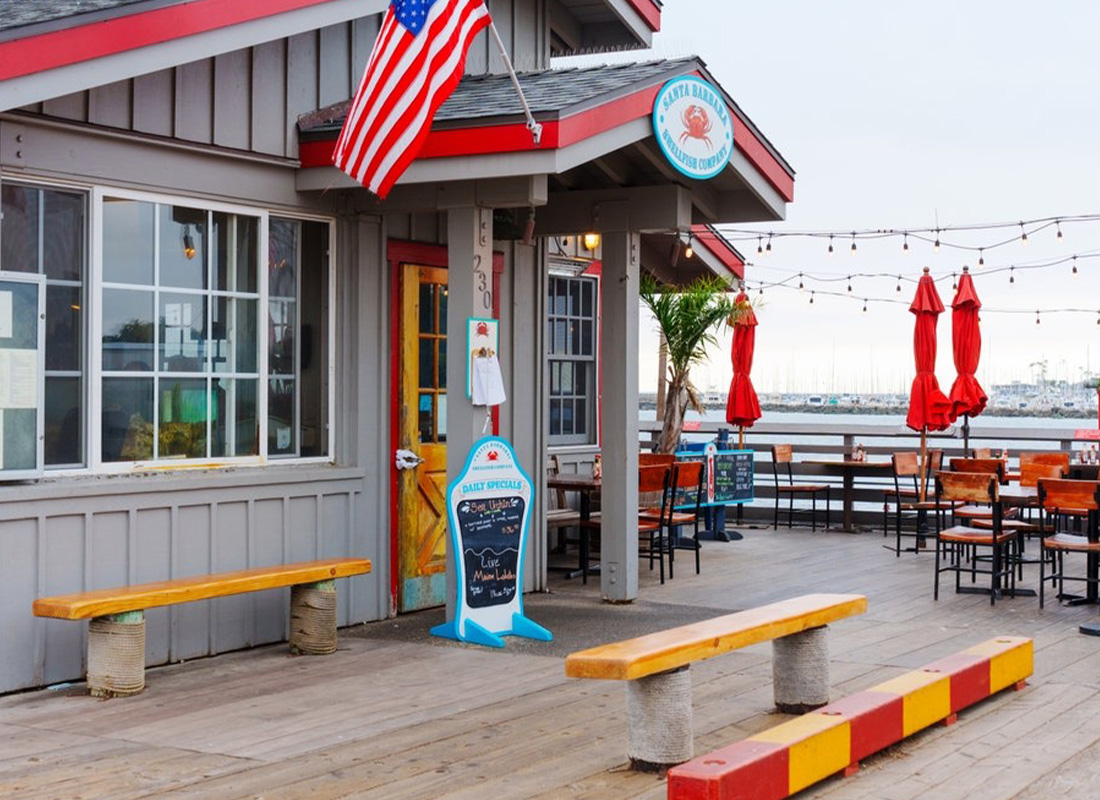
When a hurricane knocks the power out on Highway 30A, the storm is only half the loss. The other half is sitting in your walk-in cooler. A seafood restaurant in Santa Rosa Beach can lose an entire inventory of fresh catch, produce and dairy in the hours after the grid goes down — and whether that loss is paid depends entirely on how the policy was written, not on how bad the storm was.
That is the line between a restaurant policy bought on price and one built for a coastal kitchen. Fuller Insurance has written business coverage from Santa Rosa Beach since 2007, and we place restaurant insurance the way a Gulf Coast operator actually needs it: through the carriers we represent, matched to your kitchen, your menu and how close you sit to the water.
The risks that actually close a Gulf Coast restaurant
Most restaurant policies are sold as a checklist. On the coast, a few specific exposures are what really put an owner out of business — and they are the ones the cheapest quote tends to leave thin.
Losing power, and your inventory, after a storm
There is a difference between the power failing inside your building and the power failing out on the grid. A breaker trips, a line inside your walls fails — that is on-premises. A transformer blows a mile away, or the utility goes dark for three days after a hurricane — that is off-premises. Many standard property forms cover the first and quietly exclude the second unless an off-premises utility-interruption endorsement is added. For a seafood house, an ice cream shop or a breakfast spot running full coolers, that distinction is the whole loss. Spoilage coverage pays for inventory ruined when the temperature climbs; food-contamination coverage is separate and responds when food is made unsafe by something like bacteria or a foreign substance. How much off-premises power loss is actually covered, and at what sublimit, is a feature we read on your specific policy and confirm with you before you bind.
The equipment itself breaking down
A kitchen runs on machinery, and machinery fails on its own — no fire, no storm, no break-in. A walk-in compressor burns out, the HVAC quits in July, an oven, a fryer or the ice machine dies mid-service. Standard property is built around outside causes of loss; equipment breakdown coverage answers the internal failure, and it can pick up not just the repair but the spoiled inventory and the income lost while you are down. For a restaurant it is one of the most-used coverages on the policy and one of the most-overlooked on a cheap quote.
Wind, and the season you cannot get back
Along 30A, windstorm is usually the single largest and hardest-to-place piece of a commercial property bill. It is also why business income and extra expense matter more here than almost anywhere. A tourist-season closure — a hurricane in the middle of your busiest months, or a long rebuild after a covered loss — is revenue you never make up. We write the wind and the business income to the coastal reality, not to an inland assumption.
A guest slips, or a plate makes someone sick
General liability is the backbone. Slip-and-fall on a wet floor is the highest-frequency restaurant claim, and foodborne-illness and product-liability exposure is the long-tail one — the U.S. Centers for Disease Control and Prevention estimates roughly 48 million people get sick from foodborne illness each year, about one in six Americans. General liability is where premises and product claims live, and it is written to a limit that fits a real kitchen.
Serving beer and wine, even a little
Here is the trap that catches small restaurants: a standard general liability policy excludes claims arising from alcohol. So the café that “only serves beer and wine” has no liquor coverage at all unless a separate liquor-liability policy or endorsement is in place. Florida’s dram-shop statute, Fla. Stat. §768.125, is one of the most vendor-friendly in the country — a business generally is not liable simply for serving an adult, with the real exposure being service to a minor or to someone known to be habitually addicted — but a friendly statute does not stop a lawsuit from being filed or defense costs from mounting. For the restaurants we insure, we keep this at a sensible, low-to-middle level that fits a food-first operation; if your spot has a small bar or a later-night crowd, we also confirm the assault-and-battery terms in writing before you bind. We are not a bar-and-nightclub shop, and we do not chase high liquor risks.
How we place a coastal restaurant
Being independent is only worth something if the agent knows where your risk actually fits. A Gulf-front seafood restaurant is a different underwriting animal than the same restaurant five miles inland, and some of the standard carriers restaurants rely on will not write a kitchen that sits right on the water — their guidelines rule out restaurants adjacent to or with direct access to the shoreline. Carriers also differ sharply on things like outdoor smokers and grills, raw-bar and sushi prep, and open-flame cooking. Knowing that in advance is the difference between a clean placement and a wasted week.
For the restaurants that admitted carriers will not touch on the coast, we build the coverage in pieces: a package for the general liability, contents and business income, then a separate wind policy placed through a coastal wholesale market to carry the hurricane exposure the package excludes, and flood written on its own through the National Flood Insurance Program or a private market. Some of these specialty and wholesale markets are non-admitted surplus-lines carriers, and we walk you through exactly what that means before you buy. Every term is subject to underwriting.
The point is not one product. It is having enough markets, and enough coastal know-how, to get your restaurant covered the right way.
Every kind of food business on 30A — not only the ones with four walls
The Emerald Coast food scene is not just sit-down restaurants, and neither is what we write.
Main-street and hometown restaurants. Local seafood houses, breakfast spots, sandwich shops, ice cream shops and non-chain fast-casual kitchens — the independent operators who are the backbone of Santa Rosa Beach, Seaside, Grayton Beach, Rosemary Beach, Miramar Beach, Destin and the Panama City Beach corridor.
Food trucks that move. A truck that drives between locations carries an exposure a building never does: the vehicle itself. That needs commercial auto for physical damage and liability on the truck, and commercial auto generally will not cover the cooking equipment bolted inside or the gear and inventory you carry — that is property and inland marine. We write food trucks through a true mobile-vendor program, with the general liability following you to every stop and event.
Food trailers that stay put. A trailer parked permanently in one spot has no driving exposure, so it is insured more like a fixed location than a vehicle — the equipment and the stand covered as property, and the tow vehicle, if any, handled separately. Getting that distinction right is the difference between an over-priced policy and an under-covered one.
Pop-up drink stands and specialty smoothie operations. The newer corner of the market — non-alcohol drink stands, specialty smoothie booths, seasonal pop-ups working festivals, farmers markets and special events. These need special-event general liability and the vendor coverage and additional-insured endorsements festivals require, plus product liability and equipment coverage for the blenders, coolers and perishable ingredients. For an operator working several events a year, an annual policy usually beats buying one-day coverage every weekend.
Whatever shape your food business takes, the licensing side matters too: Florida runs restaurants through the Department of Business and Professional Regulation, and mobile operators through a separate Mobile Food Dispensing Vehicle license. We insure to the way your operation is actually licensed and run.
Why Emerald Coast owners work with Fuller
We are an independent agency in Santa Rosa Beach, licensed across Walton, Okaloosa and Bay Counties, and we have placed coastal business coverage here since 2007. We are not a call center reading a script, and we are not tied to one company’s appetite. We know which carriers back away from the water, which ones will not touch an outdoor smoker, and how to package wind, flood and property so a coastal restaurant is actually covered — not just quoted. If you own a restaurant, run a truck, or are standing up a stand for the season, we will tell you plainly what you need and what you do not.
Call 850-622-5283 or request a quote, and talk to a licensed agent who lives and works on 30A.
Restaurant Insurance
Does my restaurant policy cover food spoilage if a hurricane knocks the power out?
Only if it is written to. There is a difference between power failing inside your building and power failing out on the utility grid, and many standard property forms cover the on-premises failure while excluding the off-premises one unless a utility-interruption endorsement is added. In hurricane country that off-premises coverage is the whole loss, because a grid-down event after a storm can ruin a full walk-in of inventory. We read your specific policy for how off-premises power loss is handled and the sublimit that applies, and confirm it with you before you bind. Terms are subject to underwriting.
My café only serves beer and wine. Do I really need liquor liability?
Yes. A standard general liability policy excludes claims arising from alcohol, so a restaurant that serves any beer or wine has no coverage for an alcohol-related claim unless a separate liquor-liability policy or endorsement is in place. Florida’s dram-shop law, Fla. Stat. §768.125, is vendor-friendly and generally does not hold a business liable simply for serving an adult — the real exposure is service to a minor or to someone known to be habitually addicted — but that does not stop a suit from being filed or defense costs from adding up. For food-first restaurants we keep liquor liability at a sensible, low-to-middle level.
I run a food truck that moves between locations. How is that different from insuring a restaurant with a building?
A food truck adds an exposure a building never has: the vehicle itself. That means commercial auto for physical damage and liability on the truck, and commercial auto generally will not cover the cooking equipment installed inside or the gear and inventory you carry, which are handled as property and inland marine. You also need general liability that follows you to every stop and event. We write food trucks through a true mobile-vendor program that bundles these together on one account.
My food trailer stays in one spot. Is it insured like a food truck or like a building?
More like a fixed location than a vehicle. A trailer that is parked permanently in one place has no driving exposure of its own, so the trailer and its equipment are typically covered as property, and any tow vehicle is insured separately. That distinction matters — insuring a stationary trailer as if it were a moving truck usually means paying for auto coverage you do not need, while insuring it too lightly can leave the equipment underprotected.
Can you insure a pop-up drink stand or a smoothie booth for festivals and special events?
Yes. Non-alcohol drink stands, specialty smoothie booths and seasonal pop-ups typically need special-event general liability, along with the vendor and additional-insured endorsements that festivals and markets require, plus product liability and coverage for equipment like blenders, coolers and perishable ingredients. For an operator working several events a year, an annual general liability policy is usually more cost-effective than buying one-day coverage for each event.
My seafood restaurant sits right on the water. Why do some carriers turn it down?
Because a kitchen adjacent to or with direct access to the shoreline falls outside some standard carriers’ guidelines — several regional carriers restaurants otherwise rely on will not write a restaurant right on the water. That is exactly where an independent agent earns their keep: we know in advance which markets back away from the water, and we place those risks through specialty and coastal wholesale carriers instead, then package wind and flood separately so the restaurant is properly covered. Some of those markets are non-admitted surplus-lines carriers, and we explain what that means at quote.
What is equipment breakdown coverage, and why does a restaurant need it?
Equipment breakdown covers the sudden, accidental internal failure of mechanical and electrical equipment — a walk-in compressor burning out, the HVAC quitting, an oven, fryer or ice machine failing — when there is no fire, storm or theft involved. Standard property is built around outside causes of loss, so it often will not respond to the equipment simply breaking on its own. For a restaurant it can pick up the repair, the spoiled inventory and the income lost while you are down, which makes it one of the most frequently used coverages on a kitchen’s policy.
Let’s Get Started
Restaurant Insurance Quote Request
"*" indicates required fields
Don’t like forms? Contact us at or email us.